

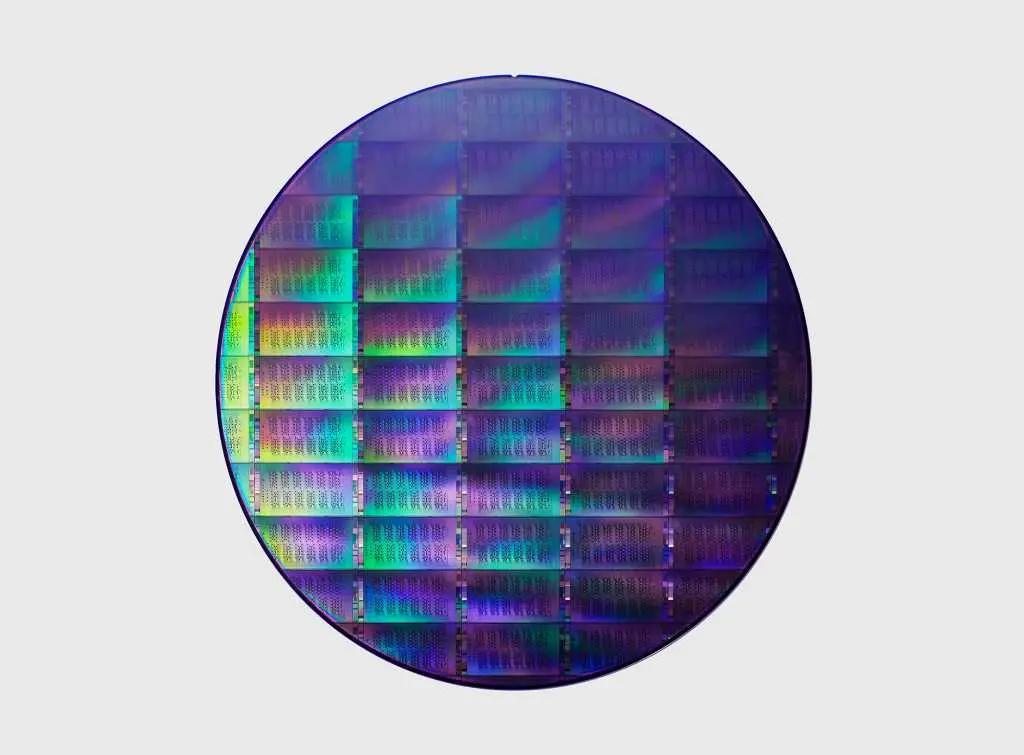
IBM hopes to build on its expertise to develop wafers for other vendors.
That's no moon. Credit: IBM
The US government has awarded IBM $1 billion to help establish the first purpose-built quantum chip fabrication unit in the US. The Trump administration's investment is being matched by IBM itself and will result in the establishment of a new company called Anderon. The new business will build its factory in Albany, New York.
IBM has pioneered quantum computing for decades. "Our work in silicon wafer fabrication has been a key to IBM's success and will be critical to enable a broader quantum technology landscape," said IBM CEO Arvind Krishna. "Anderon will be well-positioned to fuel America's fast-growing quantum technology industry."
Anderon will, with IBM's help, develop quantum wafers for a number of hardware vendors. The US government also invested in several other companies in the quantum area. GlobalFoundries, D-Wave Quantum and Rigetti Computing also benefited from the administration's interest in the technology.
The announcement marks a significant step in the United States' push to lead in quantum computing. While classical computers rely on bits that are either 0 or 1, quantum computers use qubits, which can exist in multiple states simultaneously. This property, known as superposition, combined with entanglement and interference, promises to solve certain problems that are intractable for even the most powerful classical supercomputers.
IBM has been at the forefront of quantum computing for many years. The company launched its first quantum computer on the cloud in 2016, and since then has delivered increasingly powerful systems. The IBM Quantum System One and System Two are notable milestones. However, fabricating the specialized chips needed for quantum processors has remained a challenge. Traditional semiconductor fabs are optimized for classical silicon logic, not for the delicate qubit structures that often require exotic materials like superconducting niobium or trapped ions.
By building a dedicated foundry, IBM aims to address the unique requirements of quantum chip manufacturing. The facility in Albany will be equipped to handle processes such as lithography, deposition, and etching at extremely low temperatures. The foundry will also develop new techniques to package and test quantum processors, ensuring high coherence times and low error rates.
The choice of Albany is strategic. New York state has long been a hub for semiconductor research and manufacturing. The Albany Nanotech Complex is home to the SUNY Polytechnic Institute and several chipmaking R&D centers. IBM's own research lab in Yorktown Heights, New York, has contributed to many breakthroughs. Proximity to talent and supply chains will help Anderon ramp up production quickly.
The investment comes at a time when the global quantum computing market is expected to grow rapidly. According to some estimates, the market could reach $65 billion by 2030. Both the public and private sectors are pouring money into quantum. The US government, through agencies like the Department of Energy and the National Science Foundation, has launched multiple initiatives. The National Quantum Initiative Act of 2018 authorized $1.2 billion over five years. The current award to IBM is on top of that.
Additionally, other countries are not standing still. The European Union has its Quantum Flagship program, investing €1 billion. China has reportedly committed billions to quantum research, including the construction of a massive quantum laboratory. The UK, Canada, and Japan also have major programs. The US's new foundry could help maintain its competitive edge.
IBM's move also signals a shift from vertically integrated quantum stacks to a more open ecosystem. Anderon will supply wafers to other hardware vendors, not just IBM. This could spur innovation as smaller companies and startups get access to high-quality quantum chips without building their own fabs. For example, companies like D-Wave, Rigetti, and others traditionally built their own processors. Now they can focus on software and applications while relying on Anderon for fabrication.
The implications for industries are vast. Quantum computers are expected to revolutionize drug discovery, materials science, cryptography, optimization, and artificial intelligence. They can simulate molecular interactions with unprecedented accuracy, potentially finding new catalysts or drugs. In finance, quantum algorithms could optimize trading strategies and risk models. In cybersecurity, quantum-resistant encryption is becoming a priority as classical cryptosystems become vulnerable.
Of course, challenges remain. Quantum computers are still in their infancy. Error correction is a major hurdle, requiring many physical qubits to encode a single logical qubit. Temperatures must be near absolute zero, and even tiny disturbances cause decoherence. Scaling up from dozens to thousands or millions of qubits will require breakthroughs in materials and engineering. But the new foundry is a step toward mass production and reliability.
IBM has also been active in setting standards. The company is a founding member of the Quantum Standardization Initiative, which aims to create common frameworks for quantum computing. With its own foundry, IBM can lead the way in defining manufacturing processes that others may adopt.
Other companies are making moves too. Google achieved "quantum supremacy" in 2019, performing a calculation in 200 seconds that would take a classical supercomputer 10,000 years. Intel has been researching qubits using silicon spin technology, which could leverage existing CMOS processes. Microsoft pursues topological qubits, which are theoretically more stable. The competition is fierce.
The government's investment extends beyond IBM. GlobalFoundries, D-Wave, and Rigetti also received funding, indicating a broad approach. GlobalFoundries, one of the largest semiconductor foundries in the world, will work on classical chips that interface with quantum systems. D-Wave specializes in quantum annealing for optimization, while Rigetti builds superconducting qubit processors. By supporting multiple players, the US government hedges its bets and accelerates the entire ecosystem.
The Albany foundry is expected to break ground later this year, with initial production slated for 2027. IBM plans to transfer its existing quantum chip manufacturing processes to Anderon and then scale up. The company will also invest in training a new workforce, partnering with local universities and community colleges.
In summary, the $2 billion investment in a dedicated quantum chip foundry represents a significant commitment to making quantum computing a practical reality. With government backing and IBM's decades of experience, Anderon could become the central hub for quantum chip manufacturing in the US, much like how TSMC dominates classical chip production. The race for quantum advantage is accelerating, and the United States is investing heavily to ensure it stays in the lead.
Source: Network World News