

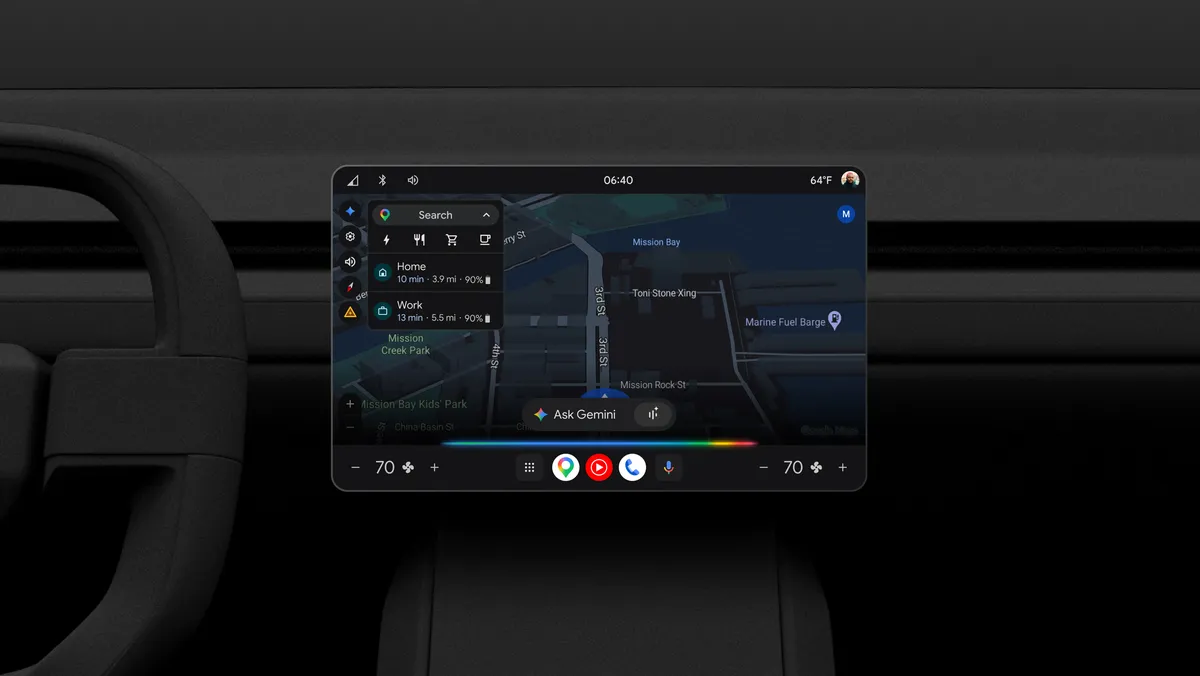
Google’s Gemini Car Rollout Brings AI to the Dashboard
Google has officially begun rolling out its Gemini AI assistant to select vehicles, marking a significant step in integrating artificial intelligence into the driving experience. The feature, announced as part of the Android Auto update, allows drivers to interact with Gemini for navigation, music control, messaging, and real-time information without taking their hands off the wheel. Early reports from Techopedia Consumer Report highlight that Gemini’s natural language processing enables more conversational commands, such as “Find a coffee shop along my route with good reviews” or “Read my latest message and suggest a reply.” The rollout initially supports cars from Volvo, Polestar, and General Motors, with more manufacturers expected later this year. This move places Google in direct competition with Amazon’s Alexa Auto and Apple’s Siri, both of which are vying for dashboard dominance. Industry analysts note that Gemini’s ability to understand context and maintain follow-up questions could give it an edge, especially as automakers prioritize seamless voice control.
FCC Proposes Tougher Robocall Rules, Raising New Privacy Questions
The Federal Communications Commission (FCC) has proposed stricter regulations to combat unwanted robocalls and robotexts. The new rules would require phone carriers to block calls from numbers that don’t appear on a verified caller ID registry, known as STIR/SHAKEN. Additionally, the FCC is considering extending these protections to text messages, which have become a growing vector for spam and phishing. However, consumer advocacy groups have raised privacy concerns about the data collection necessary to implement these blocks. The proposal would force carriers to analyze call metadata in real time, potentially exposing user behavior patterns. Critics argue that while the intent is to reduce nuisance calls, the measures could create new surveillance risks. The FCC is currently accepting public comments before finalizing the rules, expected later in the year.
Fitbit App Becomes Google Health as AI Coaching Takes Center Stage
Fitbit users are waking up to a redesigned app experience: the traditional Fitbit app has been rebranded as Google Health, integrating deeper with Google’s ecosystem including Google Fit and the Wear OS platform. The transition brings Google’s AI coaching capabilities to the forefront, offering personalized daily activity suggestions, sleep analysis, and even meal planning based on user data. According to Techopedia Consumer Report, the new platform uses machine learning to identify patterns and provide proactive health tips, such as reminding users to stand after long periods of inactivity or adjusting step goals based on recent performance. Existing Fitbit devices remain compatible, but users must migrate their accounts to Google’s servers. Privacy advocates have expressed concerns about Google consolidating health data, though the company insists that data will be anonymized and not used for advertising. The change reflects a broader strategy to make health coaching accessible to millions of users beyond the original Fitbit community.
Amazon Extends Price History Tool to One Year, Providing Much-Needed Transparency Around Deals
Amazon has updated its price tracking tool, formerly limited to 30 days, now showing a full year of price history for most products. The feature, accessible via the “Keepa” or “CamelCamelCamel” style graph on product pages, allows shoppers to see whether a listed “deal” is genuinely a discount compared to the average price over the past 12 months. This transparency is a boon for bargain hunters, especially ahead of major shopping events like Prime Day and Black Friday. The extension to 12 months gives consumers a clearer picture of pricing patterns, including seasonal fluctuations and sudden price hikes. Small business owners and resellers can also use the data to strategize inventory purchases. However, the tool only shows historical list prices, not sale prices from third-party sellers, so some caveats remain. Overall, the move is seen as a win for consumer advocates who have long criticized Amazon’s opaque pricing during flash sales.
Samsung’s Answer to Meta’s Ray-Ban Smart Glasses Revealed in Leaked Images
Leaked images purportedly showing Samsung’s upcoming smart glasses have surfaced online, offering a first look at the company’s bid to compete with Meta’s Ray-Ban Stories. The wearable appears to feature camera modules embedded in the temples, discreet buttons along the frame, and a charging case similar to theMeta Wayfarer design. Codenamed “Project Hestia,” the glasses are said to include a micro-LED display that overlays notifications and navigation cues directly in the wearer’s field of view. While the leaked images don’t reveal the final software, sources suggest integration with Samsung’s Galaxy AI and Bixby assistant. The device is expected to launch alongside the Galaxy S25 series in early 2025. Analysts believe Samsung’s version could differentiate itself through better battery life and compatibility with the wider Galaxy ecosystem. The smart glasses market remains niche but growing, with Meta’s Ray-Ban collaboration selling over 300,000 units in its first year. Samsung aims to capture a slice of that market by offering a more feature-rich alternative.
Apple Patches iPhone Bug Exploited by Police to Recover Deleted Chats, But Privacy Questions Persist
Apple has released a security update (iOS 17.4.1) that addresses a vulnerability that allowed law enforcement agencies to recover deleted iMessage conversations from an iPhone without a password. The bug, discovered by forensic firms, exploited how the Messages app stored data in system cache even after users deleted threads. Police departments worldwide had reportedly used this loophole to access encrypted chats in criminal investigations. Apple’s patch removes the residual cache and ensures that deletion fully erases data. However, privacy advocates argue that the fix does not address broader concerns about whether Apple should design its systems to make it harder for any third party—government or otherwise—to bypass encryption. The update also includes improvements to End-to-End Encryption for backup services. While Apple touts privacy as a core principle, this incident highlights the ongoing tension between security and investigatory needs.
Gemini’s ‘Continued Conversation’ Feature Makes Google’s AI More Practical for Smart Homes
Google’s Gemini assistant is introducing a “Continued Conversation” mode that allows users to string together multiple requests without repeatedly saying the wake word. For example, after asking “What’s the weather?” the user can follow up with “Set the thermostat to 72” without saying “Hey Google” again. This feature, reported by Techopedia Consumer Report, is rolling out to Nest smart speakers and displays first. It leverages Gemini’s advanced context window to remember the conversation for up to 30 seconds after a command. The improvement makes interactions feel more natural and reduces friction in multi-step tasks like controlling lights, playing music, and checking calendar events. Early adopters have noted fewer misinterpretations compared to the previous Google Assistant implementation. The continued conversation capability is a key step toward making voice assistants truly conversational, competing with Amazon’s Alexa multi-turn dialogue and Apple’s Siri enhancements.
Amazon Ending Support for Older Kindles Next Month, Showing the Hidden Cost of “Forever” Tech
Amazon has announced that it will cease support for several Kindle models published before 2013, including the Kindle Keyboard (3rd Generation) and the Kindle Touch. As of May 2024, these devices will no longer be able to connect to the Kindle Store, download new books, or sync reading progress. The move affects millions of legacy devices that are still functional for reading sideloaded content but will lose access to Amazon’s ecosystem. Amazon cites security concerns and outdated encryption standards as the reason. However, critics argue that it highlights the planned obsolescence inherent in “forever” tech gadgets—products marketed as durable but dependent on corporate support. Users who wish to continue using their old Kindles can only read files transferred via USB, and even that may become more difficult as firmware updates cease. The decision has sparked conversations about consumer rights to repair and the longevity of digital libraries.
Casely Power Banks Recalled Again Following Mid-Flight Explosion
Casely, a popular accessory brand, has issued a second recall of its power banks after a unit caught fire mid-flight on a domestic airline. The incident, which forced an emergency landing, injured three passengers and prompted investigation by the Consumer Product Safety Commission (CPSC). The recall covers approximately 200,000 units of the “Slim” series purchased between January 2023 and March 2024. The lithium-ion batteries were found to overheat due to a manufacturing defect in the charging circuit. Casely is offering full refunds or replacements, and strongly advises customers to stop using the devices immediately. This is the second recall for the brand in two years; a previous recall in 2022 involved similar overheating issues. The incident underscores ongoing safety concerns with portable power banks, especially those sold through e-commerce platforms where counterfeit or substandard components are more common. Travelers are advised to buy from reputable brands and check for safety certifications.
Techopedia uses cookies to improve and personalize your user experience. By continuing to use our site, you consent to our use of cookies as described in our Cookie Policy.
Source: Techopedia News