

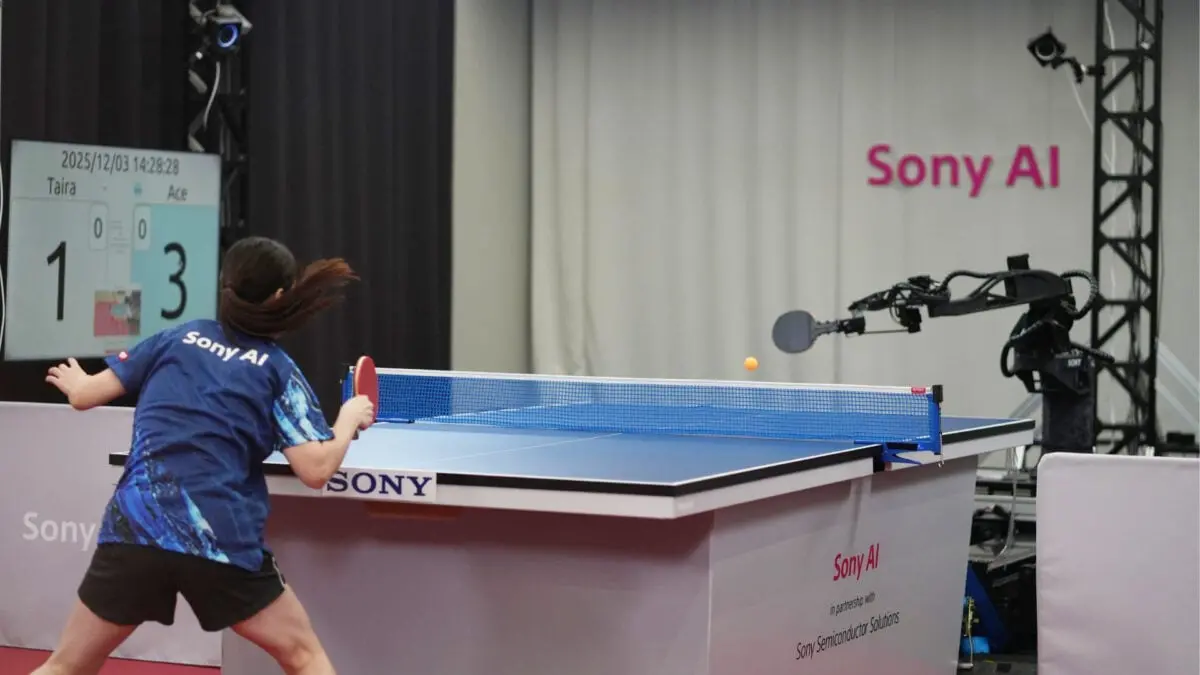
Watch out Marty Supreme, there’s a new contender for the throne of table tennis champ—and it’s not human. Research out today showcases a robot that can match and even best elite human players.
Scientists at Sony’s AI division developed the autonomous robotic system, dubbed Ace. Their study details how Ace won a majority of its matches against table tennis players with extensive experience, though it came up short against professional athletes. Novelty aside, the software and hardware that makes the robot possible could have many other uses, its creators say.
“The results of our work on Ace highlight the potential of physical AI agents to perform complex, real-time interactive tasks, suggesting broader applications in domains requiring fast, precise human-robot interaction,” lead author Peter Dürr told Gizmodo.
An ace on the court
Systems based on artificial intelligence can now regularly beat people at all sorts of tasks, including various games. Historically, though, it’s been a challenge to design robots smart and nimble enough to surpass humans at physical sports. Table tennis in particular requires fast reaction times and the ability to generate accurate, yet difficult-to-return, high-spin balls to opponents.
Scientists have been tinkering with the possibility of tennis robots since the 1980s, but ACE represents an important step forward for both artificial intelligence and robotics, according to Dürr.
“Sony AI conducted this research to study how AI could operate safely and effectively in the physical world, where perception, control, and agility must come together in real time,” he said. “Unlike simulated environments where AI can rely on perfect information, real-world sports like table tennis demand rapid decision-making based on state estimation from noisy sensors and adversarial human interactions.”
Unlike past experiments, the researchers judged Ace’s performance against humans using the actual rules of the International Table Tennis Federation (ITTF); they also recruited licensed umpires to oversee the games.
In the present study, conducted in April 2025, the researchers paired Ace against five players deemed elite, defined as people who had at least 10 years of playing experience and regularly trained 20 hours a week on average. It also faced off against Minami Ando and Kakeru Sone, two players active in Japan’s professional table tennis league.
Ace won three of the five matches against elite players. It won one game against a pro, though it ultimately lost both matches to Ando and Sone. And throughout the matches, the robot displayed agile moves and could consistently serve and return high-speed and high-spin balls. The team’s findings were published Wednesday in the journal Nature.
A future champ?
The team’s experiments didn’t stop there.
Ace had another set of matches in December 2025, where it was able to beat both elite and professional players (it won one of the two pro matches). In March 2026, it won three matches against professionals, including Miyuu Kihara, currently a top 25 player in the World Table Tennis rankings for women’s singles. During these matches, Ace displayed improved performance at shooting balls faster and more aggressively closer to the table edge, according to Dürr.
Still, Ace probably isn’t going to take over the world of table tennis. The project was devised as a way for the researchers to push the individual technologies driving Ace as far as they could, rather than any specific goal. But the lessons learned from Ace might allow scientists to create better robotic systems for various “applications across sports, entertainment, and other safety-critical physical domains,” Dürr said.
Thankfully, I’ve always been complete trash at table tennis/ping pong, so I’m already happy to accept Ace as our new robotic overlord just in case.
Background: The Evolution of Table Tennis Robots
The quest to create a table tennis–playing robot dates back to the 1980s, when early attempts were limited by slow processors and primitive motors. These machines could barely return a slow ball, let alone compete with human reflexes. Over the decades, advances in computer vision, sensor technology, and control algorithms gradually improved performance. By the 2010s, research labs at universities like TU Munich and companies like Omron developed robots that could rally with intermediate players. However, none had ever been tested under official match conditions against elite or professional opposition.
Sony’s Ace leverages years of research in deep reinforcement learning and high-speed actuation. The robot uses multiple cameras to track the ball’s trajectory at 1000 frames per second, while a neural network predicts the ball’s spin and bounce. A custom-designed pneumatic arm can accelerate up to 60 meters per second squared, allowing it to whip the paddle into position in milliseconds. This hardware is paired with a software stack that continuously adapts to an opponent’s playing style through online learning.
Technical Breakthroughs in Ace
One of the key innovations in Ace is its ability to estimate the spin of the incoming ball. Unlike position and velocity, spin is not directly observable from camera images alone. The team developed a physics-based model that infers spin from the ball’s deformation upon impact with the table and the paddle. This is combined with a Kalman filter to fuse noisy sensor data, providing a reliable estimate. Another breakthrough lies in the robot’s stroke planning: it does not simply mimic human movements but computes optimal trajectories that account for its own mechanical limits while maximizing the probability of returning the ball.
The researchers also trained Ace using a combination of simulated matches and real-world practice against amateur players. In simulation, the robot played millions of games, learning to handle a wide variety of shots. This was followed by fine-tuning in the physical world, where the robot faced human opponents of varying skill levels. The result is a system that can adapt mid-match, as seen in the December 2025 and March 2026 matches where Ace showed clear improvement against professionals.
Implications for AI and Robotics
The success of Ace has implications beyond sports. Real-time physical interaction with humans is a key challenge for many AI applications, from manufacturing and warehouse logistics to healthcare and elder care. Robots that can react safely and effectively to unpredictable human actions are essential for collaborative tasks. Ace’s ability to estimate spin and adapt to an opponent’s strategy is analogous to a robot that must anticipate a human worker’s next move in a shared workspace.
“Physical AI is still in its infancy,” says Dr. Ina Zimmermann, a robotics researcher not involved in the study. “Ace shows that we are getting closer to the point where robots can operate in dynamic human environments without causing harm or failing catastrophically. But we are still far from generalizable solutions.” Indeed, Ace is highly specialized: it only plays table tennis on a standard table with a specific paddle and ball. Generalizing to other sports or tasks would require extensive retraining.
Comparisons to Other AI Achievements
Table tennis joins a growing list of activities where AI has surpassed human performance. IBM’s Deep Blue defeated Garry Kasparov in chess in 1997, Google’s AlphaGo beat Lee Sedol in Go in 2016, and OpenAI’s Dota 2 bot crushed top players in 2019. However, these were all software-based competitions. Physical sports involve hardware constraints, real-time uncertainty, and the risk of damage or injury, making them a qualitatively different challenge. Ace is one of the first robots to compete under official rules and against professional-level opponents in a dynamic sport.
Other notable robotic athletes include the Boston Dynamics Atlas, which can perform parkour, and the Honda ASIMO, which could kick a soccer ball. However, these were demonstrations of locomotion and basic manipulation, not competitive gameplay against humans. Ace, by contrast, was specifically designed to win matches, and its success against elite players marks a milestone.
What the Future Holds
The researchers at Sony AI plan to continue improving Ace, focusing on improving its serve return and adding more variety to its shots. They also hope to make the robot more robust to different table surfaces and lighting conditions. Longer term, the techniques developed for Ace could be applied to other sports such as badminton, tennis, or even baseball, where fast reaction times and spin estimation are crucial.
Outside sports, the same sensor fusion and control algorithms could enable robots to assist surgeons in operations, sort packages in fulfilment centers, or even help elderly people with daily tasks. The key, according to Dürr, is to make these systems safe and reliable enough for real-world use. “We’re not there yet, but Ace gives us a roadmap,” he said.
For now, table tennis enthusiasts can marvel at a robot that can keep up with—and occasionally beat—some of the best human players on the planet. Whether Ace will ever challenge for a world title remains to be seen, but its existence alone is a testament to how far both AI and robotics have come.
Source: Gizmodo News