

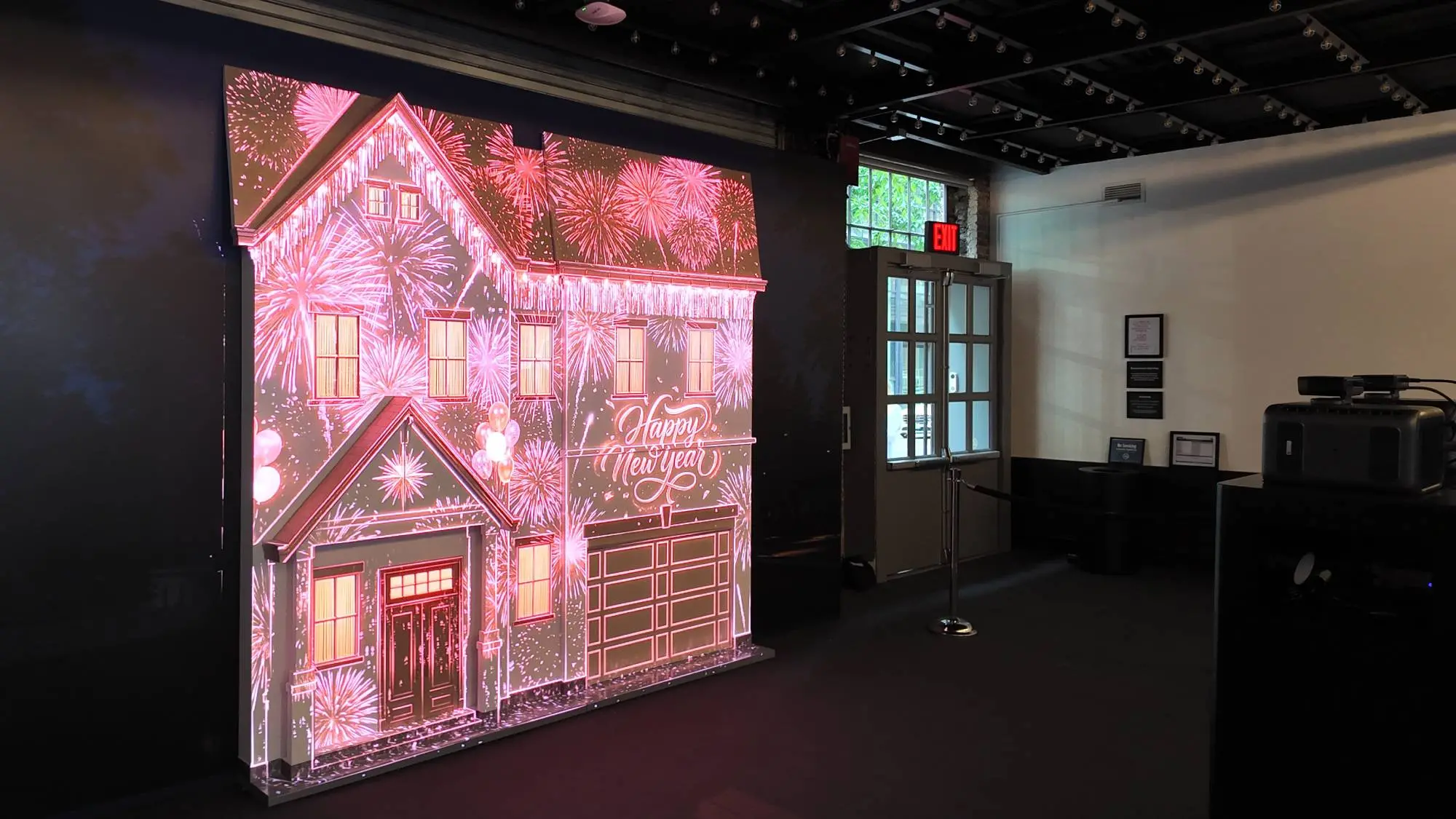
Soundcore continues to push the boundaries of home entertainment with the introduction of Nebula SpaceFlow, an innovative 3D scanner add-on designed specifically for its flagship Nebula X1 and X1 Pro projectors. This compact dual-camera accessory transforms any room into a canvas for immersive, AI-generated art.
Last year, Soundcore launched the Nebula X1 and X1 Pro, two of the most powerful projectors in its lineup. The Nebula X1 features triple-laser 4K projection, while the X1 Pro adds a built-in wireless Dolby Atmos 7.1.4 sound system. These projectors have already revolutionized home cinema experiences. Now, with SpaceFlow, Soundcore extends their utility far beyond movie nights.
What Is Nebula SpaceFlow?
SpaceFlow is a small external accessory that attaches to the front of the Nebula X1 or X1 Pro. It houses two cameras: a time-of-flight sensor and a structured light emitter. This combination allows the device to scan its environment in real-time, creating a detailed 3D model of the room, including walls, furniture, windows, and other obstacles. The technology is reminiscent of Microsoft's Kinect sensor, but optimized for projection mapping.
The scanning process is automatic and requires no manual measurements. Once the 3D model is generated, users can interact with a generative AI system. By simply describing a scene—such as "a jungle cliff covered in vines" or "a winter wonderland with falling snow"—the AI creates custom animated graphics tailored to the scanned space. The system intelligently avoids obstacles like windows or picture frames, integrating them seamlessly into the projection.
How It Works
The workflow is straightforward. After attaching SpaceFlow to the projector, users power it on and let it scan the room. The entire process takes only a few minutes. Next, via a companion app or voice command, users provide a description of the desired visual effect. The AI generates a dynamic scene, complete with motion and perspective correction. The Nebula X1 then projects the result onto the surfaces, with the image appearing three-dimensional and perfectly aligned with the room's geometry.
For example, projecting a cascading waterfall onto a blank wall makes it look as if water is flowing over the physical surface. Or, for holiday decorations, users can project virtual garlands and lights instead of hanging physical ones. The system even supports animations, bringing the scene to life with moving elements like floating leaves or drifting clouds.
Background and Context
Projection mapping is not a new concept. Artists and event planners have used it for years to create immersive installations on buildings and stages. However, traditional projection mapping requires specialized software, manual calibration, and significant expertise. SpaceFlow democratizes this technology by automating the scanning and mapping process. The integration of generative AI further simplifies creativity, allowing anyone to produce professional-quality projections without any design skills.
Soundcore, a brand under Anker Innovations, has a track record of delivering high-quality audio and projection products. The Nebula series has been praised for its portability and performance. The X1 and X1 Pro represent the premium end of the lineup, targeting home theater enthusiasts. With SpaceFlow, Soundcore ventures into augmented reality and ambient computing, blurring the line between digital art and physical space.
Technical Specifications
The SpaceFlow unit itself measures roughly the size of a smartphone and connects via a cable to the projector. It uses a combination of infrared structured light and time-of-flight measurements to capture depth data. The scanning range covers typical living room dimensions, with sub-millimeter accuracy. The AI model runs locally on the projector's processor, ensuring low latency and privacy. Users can also upload custom images or videos to project, offering further flexibility.
Comparison to Competitors
Other companies have attempted similar concepts. For instance, Sony's Xperia Touch projector could detect touch on surfaces but lacked 3D scanning. Microsoft's HoloLens uses spatial mapping for mixed reality, but it's a headset, not a projector. SpaceFlow's closest competitor might be the now-discontinued Kinect, but SpaceFlow is purpose-built for projection mapping and includes AI generation, making it more accessible.
Pricing and Availability
Soundcore announced Nebula SpaceFlow with a standard retail price of $799. However, early adopters can purchase it at an introductory price of $399. This promotional offer is expected to be time-limited. The accessory is compatible exclusively with the Nebula X1 and X1 Pro projectors. Soundcore also plans to release software updates that enhance the AI's capabilities over time, adding new visual styles and animation presets.
The product is available starting today through Soundcore's official website and select online retailers. Given the niche nature of projection mapping, the target audience includes tech enthusiasts, home decorators, event planners, and anyone who wants to transform their living space with minimal effort.
Potential Use Cases
Beyond home decoration, SpaceFlow has practical applications. In education, teachers could project interactive diagrams onto classroom walls. In retail, stores can create dynamic window displays without physical setup. For artists, it offers a new medium for digital art. The possibilities are vast, limited only by imagination.
Limitations and Considerations
While impressive, SpaceFlow has some constraints. The projection relies on the projector's brightness and ambient light conditions. For best results, a dark or dimly lit room is recommended. The scanning works best on plain, non-reflective surfaces. Complex geometries with sharp angles might cause minor distortions. Additionally, the AI-generated scenes are currently limited to descriptions; users cannot upload their own 3D models yet, though future updates may change that.
Looking Ahead
Soundcore's introduction of SpaceFlow signals a growing trend of integrating AI with projection technology. As hardware becomes more powerful and AI models more sophisticated, we can expect even more seamless blending of digital content with physical environments. For now, SpaceFlow offers a glimpse into a future where our homes become dynamic canvases, responding to our whims with stunning visuals. The $399 introductory price makes it an attractive entry point for early adopters eager to experiment with this technology.
The projector market itself is evolving rapidly. With the rise of short-throw laser projectors and increasingly compact designs, the barrier to entry for high-quality projection is lower than ever. Soundcore's Nebula line has been a strong contender, and SpaceFlow adds a unique selling point that competitors currently lack. As other brands scramble to develop similar solutions, Soundcore has taken an early lead in consumer-grade projection mapping.
In summary, Nebula SpaceFlow represents a convergence of 3D scanning, generative AI, and high-fidelity projection. It empowers users to turn their homes into immersive art installations with minimal effort. Whether for entertainment, decoration, or practical applications, the system delivers impressive results that rival professional setups. With its launch, Soundcore invites everyone to become a digital artist, transforming the way we interact with our living spaces.
Source: Android Authority News