

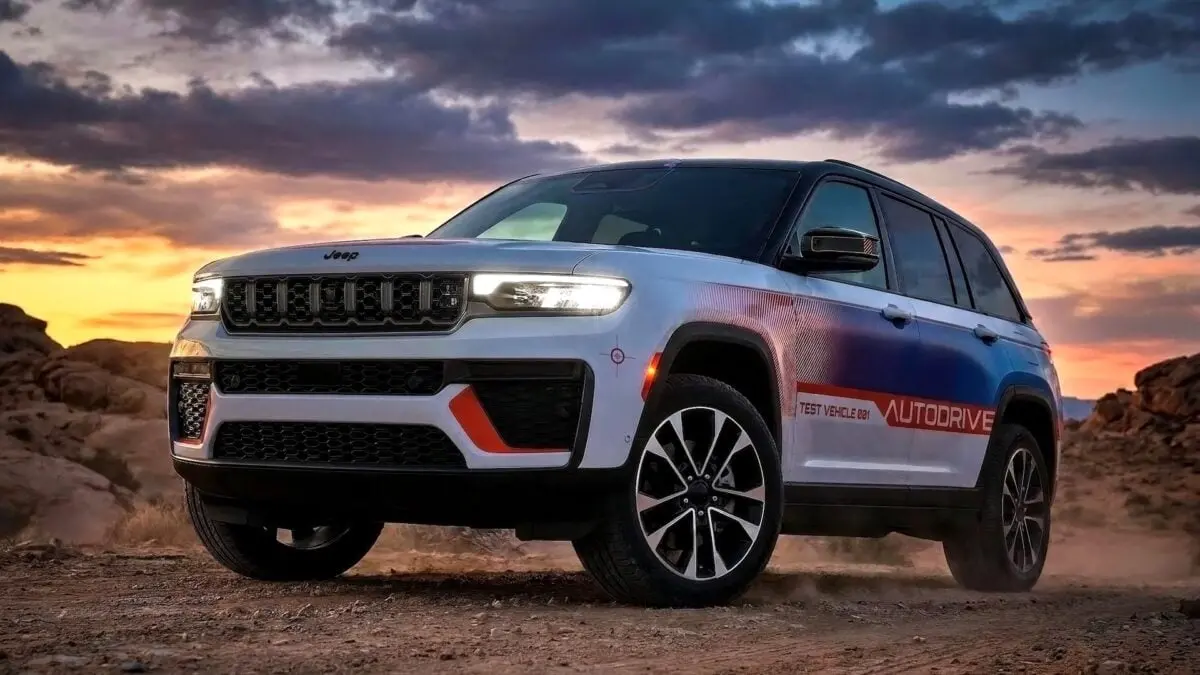
As robotaxi services steadily pop up in cities around the world, self-driving tech in commercial passenger cars has been slow to catch up. Stellantis, the parent company of Jeep, Ram, Dodge, Fiat, and several other car brands, is the latest automaker to announce plans to bring more advanced automated driving tech to its vehicles.
The company announced Thursday a new strategic technology partnership with U.K.-based startup Wayve. The partnership aims to integrate Wayve’s AI Driver system into Stellantis’ STLA AutoDrive platform. That could eventually equip some Stellantis vehicles with hands-free, supervised driving tech that works on both city streets and highways, similar to systems already available on Tesla and Rivian vehicles. Stellantis and Wayve are describing this first iteration as a Level 2++ system, meaning drivers would still need to pay attention to the road and supervise the vehicle as it drives.
What is Level 2++? According to the Society of Automotive Engineers (SAE), Level 2 automation means the vehicle can control steering, acceleration, and braking under certain conditions, but the driver must monitor the driving environment and be ready to take over at any moment. The “++” designation, used by a few automakers, indicates that the system can operate hands-free on highways and some city streets while still requiring driver supervision. This is a step below Level 3, where the vehicle can handle all driving tasks under specific conditions and the driver can disengage attention, but it is still a significant leap from the adaptive cruise control and lane-keeping assist common in many modern vehicles.
The first vehicle integration is planned for North America in 2028. Stellantis says the platform can support more advanced automated driving features down the road as regulations and customer expectations evolve. While there is no word yet on which specific brands or models would get the tech first, Wayve developed a prototype with Stellantis in just a few weeks on the company’s Jeep Cherokee platform. This rapid integration suggests that Stellantis is eager to bring advanced driver-assistance systems to its lineup, which currently lacks a true hands-free highway system like Ford’s BlueCruise or General Motors’ Super Cruise.
Founded in 2017, Wayve is a London-based startup that makes autonomous-driving software learning from real-world traffic using cameras and machine learning. This theoretically eliminates the need for detailed maps that its competitors rely on. Instead of building its own driverless cars, Wayve is focused on the software, which it says is vehicle-agnostic, meaning it can be adapted to work on everything from passenger cars to delivery vans. The company’s approach is based on end-to-end deep learning, where the AI is trained on vast amounts of driving data to predict the best actions for a given situation. This contrasts with the modular approach used by companies like Waymo or Cruise, which rely on high-definition maps and separate systems for perception, decision, and control.
The buzzy startup announced earlier this year that it had closed a $1.2 billion Series D investment round with a range of investors, including SoftBank, Microsoft, Nvidia, and Uber. And just last month, Advanced Micro Devices, Arm, and Qualcomm Ventures announced a separate $60 million investment in the company. Uber’s investment will specifically support Wayve-powered robotaxis on the Uber platform. The companies intend to launch their first service in London in 2026, with plans to expand across multiple markets. This partnership with Stellantis marks a major expansion of Wayve’s footprint from robotaxis to mass-market consumer vehicles.
Nissan has also signed on to use Wayve’s technology. In December, the automaker announced that it would integrate Wayve’s tech into a broad range of its cars starting in 2027. This means that Wayve’s software could soon power driver-assistance systems for three of the world’s largest automakers: Stellantis, Nissan, and, through Uber, potentially many more.
The autonomous driving industry has seen a lot of movement in recent years. Tesla’s Full Self-Driving (FSD) system, while criticized for its reliability, has pushed other automakers to accelerate their own hands-free driving capabilities. Rivian’s Highway Assist is also a player in this space. Stellantis, which has been slower to adopt Level 2+ systems, now appears to be making a serious commitment. The partnership with Wayve could give Stellantis a technological edge, especially if Wayve’s vision-based approach proves to be more scalable and adaptable to different vehicle types and geographies.
Wayve’s system uses a combination of cameras and deep neural networks to understand the driving environment. The company argues that this approach allows the system to handle unusual situations better than systems that rely on pre-mapped routes. For example, a Wayve-powered vehicle could navigate a construction zone or an unfamiliar side street without needing a map update, because the AI learns to interpret visual cues in real time. This is particularly important for a global automaker like Stellantis, which sells vehicles in markets with vastly different road infrastructures and driving customs.
Stellantis was formed in 2021 from the merger of Fiat Chrysler Automobiles and France’s PSA Group, making it the fourth-largest automaker in the world. The company’s brands include not only Jeep, Ram, and Dodge but also Chrysler, Alfa Romeo, Maserati, Peugeot, Citroën, Opel, and many others. The STLA platforms are designed to be flexible, supporting everything from small city cars to full-size pickup trucks. The STLA AutoDrive platform, in particular, is intended to be a scalable architecture for future electric and autonomous vehicles.
For Stellantis, adding hands-free driving is a crucial selling point as it transitions to electric vehicles. Many consumers are still hesitant about EVs, and advanced driver-assistance systems can be a differentiator. Additionally, Stellantis has ambitious plans to invest $35 billion in electrification and software by 2025. The Wayve partnership fits into that broader strategy of becoming a leader in technology, not just a manufacturer of traditional cars.
Wayve’s technology has already demonstrated its potential on public roads in the UK, where the company has been testing its AI-driven vehicles in complex urban environments. The company’s ability to bring up a prototype on the Jeep Cherokee in less than two months suggests that the integration process is smooth and that the software is indeed platform-agnostic. This could allow Stellantis to roll out the technology across multiple brands and models relatively quickly, once the initial integration is complete.
However, regulatory hurdles remain. Many countries and states have yet to finalize rules for Level 2++ and Level 3 systems. In the US, the National Highway Traffic Safety Administration (NHTSA) has been updating its safety standards, but the process is slow. Stellantis and Wayve are likely banking on the gradual adoption of regulations that will allow hands-free driving on highways, which is already permitted under certain conditions in states like California, Texas, and Michigan.
Another challenge is consumer trust. High-profile incidents involving Tesla’s Autopilot and FSD have made some drivers wary of automated systems. Stellantis will need to educate consumers about the capabilities and limitations of the Wayve-powered system to ensure safe use. The company has emphasized that the initial Level 2++ system requires full driver attention, but as the technology evolves, they may eventually offer Level 3 or even Level 4 autonomy, where the vehicle can drive itself without supervision in defined areas.
Wayve’s partnerships with Uber and Nissan, in addition to Stellantis, position it as a key player in the autonomous driving space. The $1.2 billion funding round and subsequent investments from chipmakers also signal that the industry believes in the company’s technology. For Stellantis, this partnership is a way to leapfrog competitors who have been developing their own systems from scratch.
The future of driving is undoubtedly becoming more automated. While full self-driving cars that can navigate any road without human intervention are still years away, systems like the one Stellantis and Wayve are developing will make driving safer and more convenient. By 2028, drivers of Jeep, Ram, and Dodge vehicles may be able to take their hands off the wheel on long highway trips, trusting the AI to handle the driving while they remain ready to take over if needed.
Source: Gizmodo News